
The main difference between Nivalis Nights and Cloudpunk is your job in the city. Cloudpunk builds its experience around package delivery and a story discovered while travelling through Nivalis. Nivalis Nights puts you into a daily life and business simulation, starting with a noodle stand and expanding into relationships, restaurants, and other activities.
Both come from ION LANDS and share the city of Nivalis, but sharing a setting does not make them interchangeable. If you mainly want another driving-focused delivery adventure, Nivalis Nights changes that premise substantially. If you wanted to stop travelling past the city and establish a routine within it, its business and social focus may be closer to that interest.
The Differences That Matter Before You Choose
| Aspect | Cloudpunk | Nivalis Nights |
|---|---|---|
| Central activity | Delivering packages and following a narrative | Building businesses and managing life in the city |
| Player's relationship to Nivalis | Moving through it as a delivery driver | Spending repeated days in its districts as a business owner |
| Vehicle expectation | HOVA driving is part of the delivery experience | No direct car driving; taxis connect districts, and you can steer a boat |
| Everyday focus | Deliveries and the people encountered along the route | Venues, supplies, relationships, homes, and optional activities |
| Exploration expectation | A delivery adventure through the city | Freely explorable areas and districts, with other areas forming the background |
| Best starting reason | You want the city through a driving and story premise | You want to establish a life and businesses in the city |
These are differences in what you spend your time doing, rather than a ranking. A feature you loved in Cloudpunk may be deliberately absent from Nivalis Nights, while a place you wished you could linger may now be the centre of a recurring routine. The useful comparison starts with that change in the player's purpose.
Deliveries Give Way to Daily Responsibility
Cloudpunk's delivery premise gives movement through the city a clear reason. Packages and encounters take you from one part of Nivalis to another while the story unfolds. The driving role is part of that identity: you are travelling through the setting to carry out work and discover what is happening around you.
Nivalis Nights begins with a different responsibility. You take on a noodle stand, and developing a functioning business becomes part of establishing yourself. Ingredients, workers, customers, and the venue become recurring concerns. The official description then expands that ambition toward restaurants and nightclubs rather than toward a larger delivery operation.
That difference affects the reason to return to a familiar place. In a delivery adventure, a location can be a stop along a route. In Nivalis Nights, a venue is somewhere whose condition and operation matter again tomorrow. You are less often asking where the next package goes and more often asking how the day’s activities fit together.
Someone who enjoyed Cloudpunk primarily because it gave exploration a straightforward assignment should consider this shift carefully. Managing a routine is a different source of motivation from following a route. Conversely, someone who wanted more involvement with the city's ordinary businesses may welcome having a place to operate instead of just another destination to visit.
HOVA Driving Is a Major Point of Separation
Do not choose Nivalis Nights expecting its cars to replace Cloudpunk's HOVA experience. The official FAQ explicitly says you cannot drive a car directly. District travel uses taxis, and a boat is the vehicle you can steer yourself.
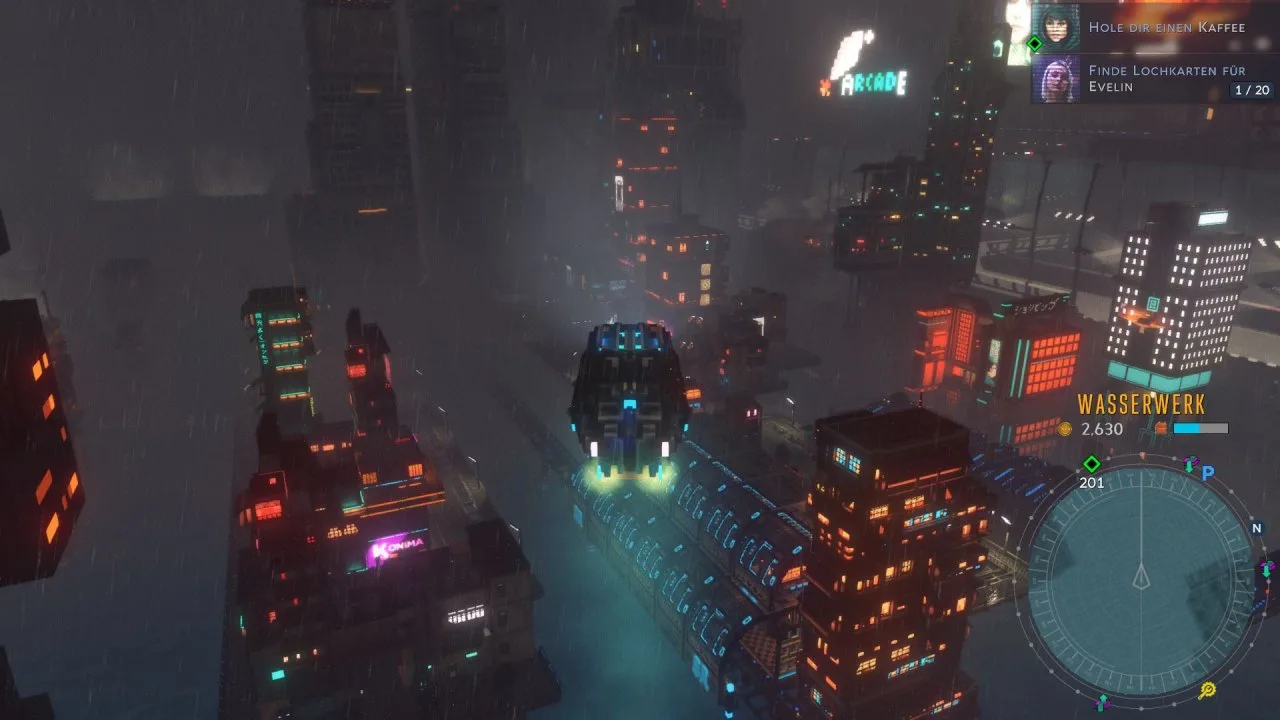
Cloudpunk gameplay: the HOVA perspective belongs to the delivery adventure, not Nivalis Nights.
The screenshot above belongs to Cloudpunk and illustrates its aerial vehicle perspective. It is included to make the comparison clear, rather than to advertise a driving feature in Nivalis Nights. A futuristic city filled with traffic does not necessarily give the player control of that traffic.
In Nivalis Nights, foot exploration lets you engage with streets and residents, while transit provides connections between districts. The boat offers a separate way to explore the ocean. This preserves movement through the setting, but it changes the sensations and decisions involved. Taking a taxi connection is not the same activity as steering a HOVA toward a delivery destination.
This is the clearest test for a returning Cloudpunk player. If manually flying through the skyline was your main reason for playing, the new game does not supply that same loop. If being in the city mattered more than piloting above it, the shift toward walking, conversation, and places you operate may still fit your preference. Detailed transit rules belong in the fast travel guide, rather than changing the central comparison.
A Large City Is Not a Promise That Every Building Is Reachable
The official explanation of Nivalis Nights distinguishes freely explorable areas and districts from parts of the world used as background. You can explore city areas and the ocean on your boat, but the FAQ does not call the game fully open world. The skyline helps establish scale without making every visible structure a player destination.
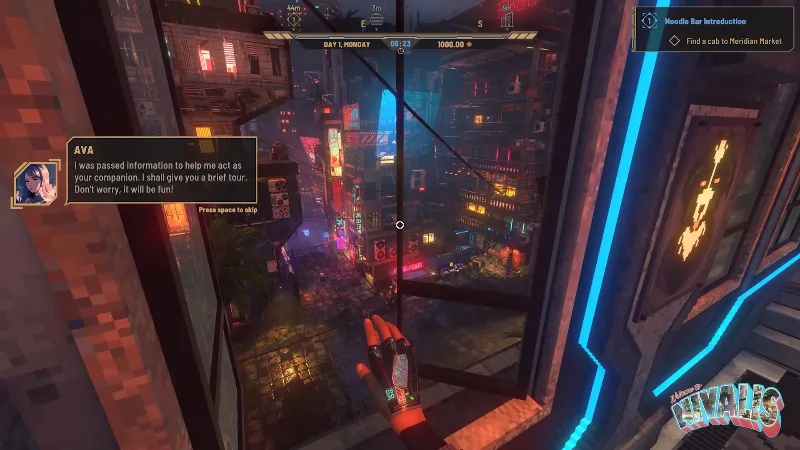
Nivalis Nights places the player at street level in a first-person view.
This distinction is useful because both games sell much of their appeal through the appearance of Nivalis. An impressive skyline can create the expectation that any balcony, tower, or road is accessible. In Nivalis Nights, the documented scope is more specific: the parts you can explore have their own activities and connections, while other parts contribute to the view.
The first-person perspective is intentional. The developers connect it to experiencing the immense scale of the city and feeling immersed within it. That puts emphasis on what the streets look like around you, rather than establishing a car-driving view simply because the setting is shared with Cloudpunk.
The comparison should therefore avoid measuring the games by a made-up count of buildings or an unsupported claim that one map is a particular amount larger. The supported distinction is the kind of access and the reason for moving through it. Nivalis Nights asks you to inhabit selected parts of the city and participate in daily life there.
Story Encounters Become Ongoing Relationships
Both games use the people of Nivalis to give the setting meaning. The difference is how those encounters fit into the main activity. Cloudpunk introduces people within its delivery-driven narrative. Nivalis Nights combines a core narrative arc with choices that influence relationships and uncover aspects of life in the city.
The new game's official description includes friendships and romance, alongside the stories of the people you meet. Those systems provide reasons to revisit the cast while also managing your own responsibilities. They do not imply that every resident has unrestricted conversation at every moment, or that the game abandons a central story entirely.
The shared setting can make returning players recognize ideas, places, or characters. That recognition is a different benefit from a promise that every familiar companion returns. In particular, the launch-era FAQ says there were no current plans for Camus to return. That should be read as the stated position at that time, rather than a permanent declaration about all future content.
If your attachment to Cloudpunk is strongly tied to a particular character, investigate that expectation directly rather than assuming the entire cast carries over. If your attachment is to the city's social atmosphere, new people and longer-running relationships may be more relevant than direct continuity.
The New Routine Includes More Than Running a Venue
Nivalis Nights' official description includes growing or buying ingredients, furnishing homes, fishing from a boat, and engaging with residents. These activities sit alongside business development. They give a day more possible directions than a single delivery route, but they also give you more responsibilities to keep in mind.
That does not make Nivalis Nights a consequence-free sightseeing mode. Early impressions describe the pressure of operating the noodle stand and dealing with debt, even while the player wanted to wander. The setting may be attractive enough to make you want to explore without interruption, but the game's business responsibilities are part of its identity.
The Character Presentation Has Changed
The smoother characters in Nivalis Nights are a documented artistic decision. The official FAQ explains that voxel-style characters were explored, but limitations appeared when the team worked on expressive animation. Traditional meshes with detailed faces were chosen, with stylized proportions and textures intended to fit the world.
This gives returning players a concrete explanation for a noticeable visual difference. The shared city does not require the same construction for every character model. A stronger emphasis on faces and expression can change the way conversations look, even when the surrounding environment retains a blocky aesthetic.
Whether you prefer one style is a matter of taste. The comparison can identify the difference without turning it into an unsupported claim about production tools or technical quality. It also should not imply a player appearance editor: Nivalis Nights' official FAQ says character customization is absent, with the player's arms and hands visible in its first-person design.
For appearance expectations specifically, the character creation explanation gives the direct answer. Here, the relevant point is that the cast's presentation changes alongside the shift in how you interact with the city.
Choosing Where to Start
Nivalis Nights is presented as a distinct experience in the city where Cloudpunk takes place. That establishes the connection, but it does not establish a mandatory play order, save transfer, or a reward for completing the earlier game. A shared setting alone is insufficient evidence for any of those requirements.
Choose Cloudpunk first if your immediate interest is the delivery adventure and its driving premise. Choose Nivalis Nights if the business and daily-life systems are what drew your attention. Returning to the same city can add familiarity, but familiarity is a benefit rather than a confirmed prerequisite for access to the new game's systems.
Do not base that choice on invented completion times. Story pace, optional exploration, and recurring management interests make a simple hours comparison difficult without a defined measurement. The stronger distinction is how you want to spend those hours: following deliveries through Nivalis or maintaining a routine within it.
If you want an overall assessment of Nivalis Nights after identifying that preference, the review addresses its appeal and friction. This comparison answers the earlier question: which version of life in Nivalis matches what you actually want to do. The shared skyline is the connection; the delivery driver and the business owner are the difference that determines your day.