
Nivalis Nights does not offer character creation or player-character customization in its launch-era official FAQ. You do not begin by selecting a face, hairstyle, body, or outfit for a third-person avatar. The game uses a first-person viewpoint, with your arms and hands as the visible parts of the player body.
That answer is separate from the game's substantial emphasis on making a life in the city. You can influence relationships, develop businesses, and furnish apartments, but those activities do not constitute an appearance editor. If you are looking for the character creation screen before starting, there is no confirmed editor to locate or unlock.
What the First-Person Design Changes
The official explanation connects the first-person perspective to the scale of Nivalis and the feeling of being inside its streets. The player looks outward at the city rather than watching a customized body move through it. That perspective changes what the game shows and where it places its customization systems.
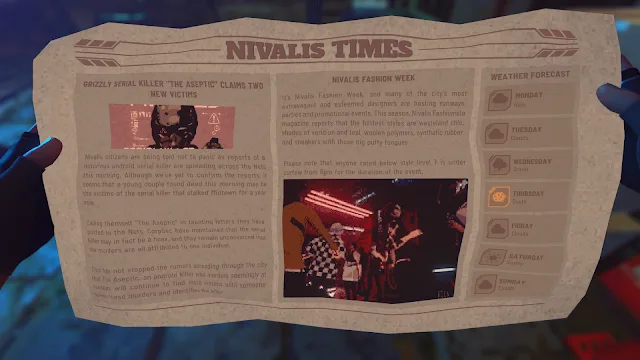
The player hands are visible while holding the newspaper; this is not an appearance editor.
Visible hands make the player's presence tangible, but they should not be mistaken for evidence of a body editor. Being able to see part of the character is different from having controls to change its appearance. The FAQ explicitly says there is no character customization and describes the game as placing you at the center of the experience without using a virtual avatar.
This also explains why screenshots dominated by buildings and people can feel ambiguous before you play. The people visible ahead are inhabitants of Nivalis. They are not necessarily alternate camera views of the player. Unless a scene explicitly establishes otherwise, a recognizable face in a dialogue interface belongs to the character you are meeting, not to a customized protagonist.
For players used to beginning a life simulator with a wardrobe and a full-body preview, this is a material difference. Nivalis Nights expresses the player's place in the world through the view, interactions, and decisions. It does not provide the same visual self-design loop as an avatar-focused simulator.
Appearance Options You Should Not Expect
There is no confirmed launch character editor for face shape, hairstyle, body type, skin selection, or clothing selection. These should not be described as hidden tabs, later rewards, or options unlocked by an apartment. The absence of an editor is an explicit feature limitation, not a puzzle requiring progress through the opening story.
The same caution applies to a supposed gender-selection screen. The official explanation does not establish a menu for selecting a player gender or changing the visible body. Character customization should not be inferred from the game having romance, dialogue choices, or diverse NPCs. Those systems concern interactions with characters, rather than an appearance configuration for the player.
Nor should a character's portrait be interpreted as a name-and-face setup for your own avatar. Interfaces can show information about people you know while giving you no ability to edit your own appearance. Looking at what a panel actually contains is more useful than assuming that every character-related menu is a character creator.
This makes the initial answer practical: you do not need to restart repeatedly to find a missed creator, or keep advancing solely in the hope that an unsupported editor will appear. If visual identity is a deciding feature for you, treat it as absent under the documented launch design. An update would need to explicitly change that situation before a different answer would be justified.
NPC Models Are Not Player Customization
The game has distinctive residents with faces, clothing, and dialogue portraits. Those designs are part of the cast. Meeting a person with a particular appearance does not mean the same options are available to the player, and photographing that person does not turn the model into a player avatar.
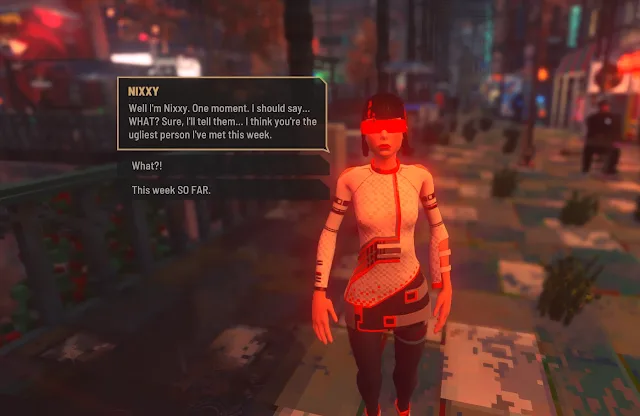
Nixxy is a resident you meet, not a customizable player avatar.
The portrait above identifies an NPC in a conversation. It helps you recognize whom you are addressing. It is useful to distinguish this from an editor preview: there are no appearance controls being demonstrated by that portrait. A screenshot of a named character can illustrate the cast without supplying any evidence of customizable player faces.
The official FAQ also explains why these people do not use the same voxel construction as the environment. During development, the team explored voxel-style characters but encountered limitations when working on expressive animation. Traditional meshes with detailed faces and stylized proportions were chosen instead.
Menus About People Serve Other Purposes
As you meet residents, the game gives you reasons to track conversations and relationships. A character list is a way of keeping track of the city’s cast. It should not be assumed to contain an edit function for the protagonist simply because it is a menu about characters.
Staff recruitment is another potential source of confusion. A recruitment interface displays workers, their skills, expected hours, and wages so that you can choose someone for a business role. You are choosing an employee, not creating your own character. The visible candidate portraits are information about the candidates being considered.
If you are looking for recruitment rather than player identity, the staff hiring guide covers that separate task. The character creation question ends with whether you can design the player’s appearance; it does not require learning how to select or schedule workers.
Personalizing Your Surroundings
Apartment furnishing is one of the game's confirmed forms of personalization. The official FAQ describes placing paintings, lights, furniture, and other items, with some apartments offering balconies or terraces. Those choices change the space you spend time in, rather than the body from which you view it.
For someone attracted to character creation because it allows visual expression, this may still be relevant. Choosing a room's atmosphere provides a different kind of authorship: the objects and arrangement communicate your preferences. It does not substitute mechanically for choosing a hairstyle or outfit, and it should not be advertised as if it did.
Business development offers a similar separation. Building a venue gives your playthrough a focus and a visible place in the city. The business is something you operate; it is not a player-model editor. If the absence of an avatar editor is acceptable, these systems may provide the personalization you actually wanted. If the appearance of a persistent on-screen protagonist is essential, they meet a different need.
Choices Shape a Role, Not a Body
The game's core narrative includes choices that influence the experience and relationships. This allows a role to emerge through how you engage with the city. It does not mean those choices alter a player model or unlock a visual editor.
You can think of the distinction in terms of what a decision changes. A relationship decision changes how an interaction develops. A furnishing choice changes a room. A business decision changes what you are doing with your day. A character creation decision would change the protagonist’s configured appearance. Only the last category answers the appearance question directly.
Players who enjoy deciding how to act may find plenty of room for a personal style of play. Players who mainly enjoy designing a character to look at throughout the game should judge the first-person arrangement on its own terms. Both preferences are understandable, but they point to different systems and different reasons to play.
Photo Mode Does Not Create an Avatar
Nivalis Nights has a photo mode for capturing the city and its atmosphere. Camera controls can change how a scene is framed, which is different from creating a new player model. A photograph containing an NPC should not be presented as a screenshot of a customizable protagonist.
This becomes particularly important when a close-up of a resident resembles a portrait taken in a character creator. A close camera angle can reveal details that are less obvious during ordinary exploration. It cannot establish appearance choices that are absent from the game's documented design.
Likewise, changing a crop or selecting a picture for a frame personalizes an image and its presentation. It does not change the identity of the person photographed. The photo mode guide explains that camera workflow separately, without treating it as a substitute for a missing character editor.
Future Changes and Unsupported Workarounds
The official FAQ uses a current-state description of character customization. That establishes the documented design at the time of the launch-era explanation. It should not be converted into a guarantee that an editor will arrive, or a claim that the feature can never be added.
A future change would need an explicit announcement or a working appearance interface. A community wish, an old discussion of preferred character styles, or a picture of an NPC would not supply that confirmation. Until the design changes, planning a playthrough around an eventual body editor adds an expectation the game has not established.
The FAQ also does not place official modding tools within the game's scope. That means a promised easy mod-based character creator should not be treated as an established alternative. Changing an interface or taking different screenshots would still not demonstrate a complete editor for a player body.
The useful decision is therefore about the documented experience available to you: a first-person life and business simulation with visible arms and hands, a designed cast of residents, and personalization through spaces and choices. If you want a customized avatar as the central visual feature, Nivalis Nights does not currently meet that requirement. If you want to look out into Nivalis and shape a life there, its other systems explain where that sense of ownership comes from.