
To hire staff in Nivalis Nights, use a hiring computer, select the restaurant you want to recruit for, and open the new-worker list. Compare the candidates' skills, expected working hours, and pay before hiring. Then assign the employee a job, set their shift, and adjust their wage until the arrangement keeps them happy.
At Ramen Noir, your first staffing objective is to hire a waiter to help Banor. Hiring someone is only the first part of that objective: a worker needs the right role and a shift covering the period when you expect them to help. A new name on the staff list does not, by itself, show that your service problem has been solved.
Reach the First Waiter Objective
Banor is already helping at the noodle bar when you take it over. During the opening restaurant sequence, you set up service, restock the kitchen, and speak to nearby restaurant owners about recipes. After the Beer recipe step, return to Banor. His request for a waiter introduces the ordinary employee system.
Follow the active restaurant objective rather than treating staff recruitment as a separate relationship quest. You can begin with the workers offered by the hiring interface. Some additional workers can become available through conversations or quests, but that does not make completing every candidate's personal story a prerequisite for your first hire.
The number of employees you can hire depends on the venue's level. Use the current capacity shown for your restaurant. A limit displayed at the beginning of one playthrough is not a universal cap for every venue or later upgrade.
Select the Venue Before Choosing a Candidate
Interact with a hiring computer or the nearby hiring board and select the restaurant receiving the new worker. At Ramen Noir, the recruitment interface is also associated with the venue's staff controls. Check the restaurant name before comparing candidates, particularly once you own more than one business.
The staff screen distinguishes your existing employees from the people available to hire. Enter the new-worker selection instead of assuming that clicking an employee already on the roster will recruit someone else. The illustrated Ramen Noir interface shows a Staff tab and a Hire New Worker panel, with job categories beside the candidate cards.
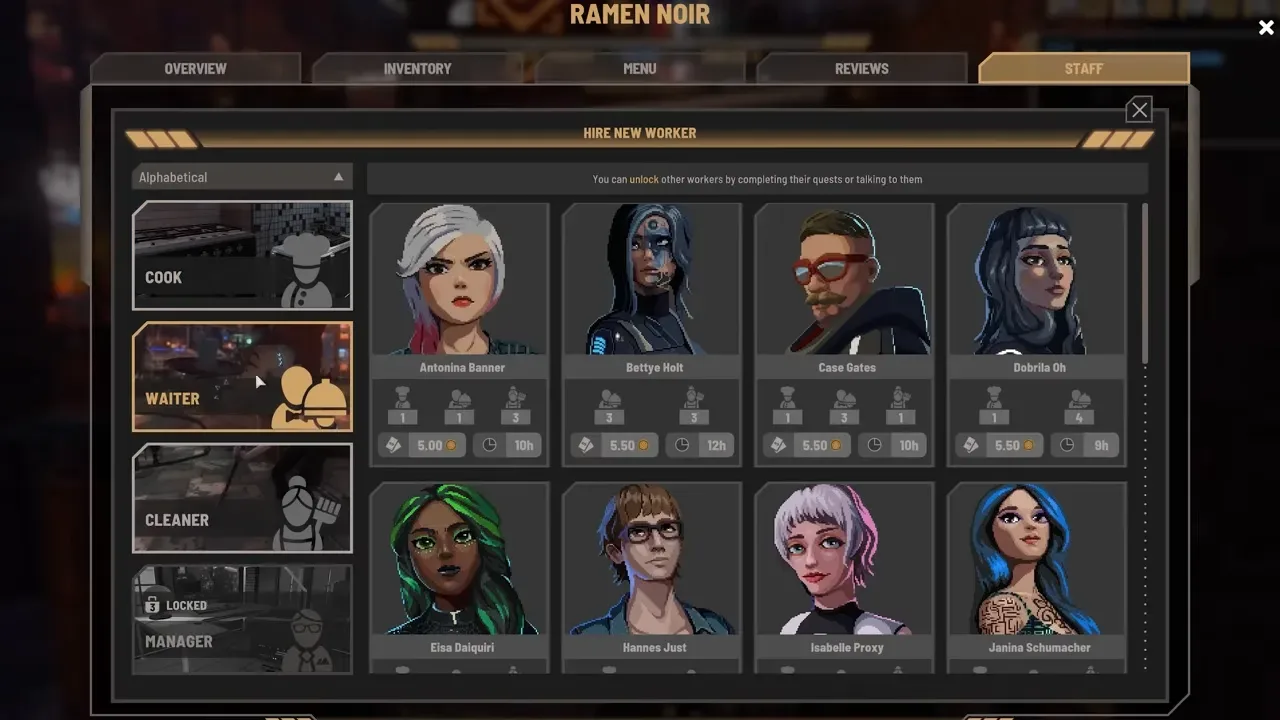
Compare the relevant role skills with each candidate’s expected hours and wage before hiring. The values shown belong to these candidates.
Each candidate can have different strengths across the available roles. A person who looks suitable at a glance may be much better at another job. Read the skill information and the employment expectations together before choosing. The useful question is whether this person fits the vacancy you have, not whether their card contains the largest number anywhere on it.
Do not copy the wages or shift lengths visible in an illustration as permanent requirements. Those figures belong to the displayed candidates. Read the values for the worker you are hiring in your own staff screen.
Match Skills to the Work You Need
Ordinary restaurant work is divided between cooking, waiting, and cleaning. The role assignment tells the worker what you want them to cover, while their relevant skills help you compare candidates for that assignment.
| Role | Work to cover | What to compare before hiring |
|---|---|---|
| Cook | Preparing the food your restaurant serves | Cooking ability, expected hours, and wage |
| Waiter | Serving prepared food to customers at tables | Waiting ability and coverage during service |
| Cleaner | Clearing dirty plates and cleaning the restaurant area | Cleaning ability and a shift that covers the work |
Skills are not identical across workers. Some people have useful ability in several jobs, while others specialize more narrowly. Compare the role you intend to assign first, then consider whether a second useful skill would help your small team.
Workers develop their skills as they work. A low starting value does not mean the candidate can never improve, but it also does not justify ignoring the job they need to perform today. Choose a worker who can cover the immediate vacancy and let their later development remain a separate consideration.
Assign the Job After Hiring
Once you have recruited the candidate, return to the employee's staff controls and check the assigned role. Do not leave that check to their appearance, the category you browsed, or the fact that they now appear on the restaurant roster.
A practical first-hire sequence is:
- Select Ramen Noir in the recruitment interface.
- Compare available workers for the waiter vacancy.
- Hire the selected candidate.
- Open the new employee's settings and confirm their Waiter assignment.
- Set a shift covering the service period you need.
- Check the happiness indicator after adjusting hours and pay.
The game allows an employee to cover more than one job. It also allows several workers with the same role to work at the same time. You do not have to choose between a single waiter for the entire restaurant and a team where everyone has a different title.
Dual assignments can be useful when the team is small and a worker has skills in both jobs. However, assigning Cook and Cleaner to one person still places both responsibilities on that person. A second role does not create a second employee. If you are hiring to cover a particular missing job, verify that the change adds real coverage rather than moving the same worker between two demands.
Set Hours Around the Restaurant's Service
The shift controls determine when the employee is scheduled to work. Start with the restaurant hours you want covered, then compare that period with the worker's expected working hours. You are arranging a job for a particular venue, so copying another player's timetable is less useful than checking your own service period.
If the first waiter finishes before the period when you need help, hiring was successful but scheduling remains incomplete. Extend or move the shift to cover that gap, then check the worker's happiness again. Longer hours can make an employee less satisfied, so treat the schedule and wage as connected settings.
Avoid using the longest possible shift as the default answer to every staffing problem. It may provide more coverage while producing an unhappy arrangement. A shorter or better-aligned shift may fit the role you need, and a different candidate may have employment expectations that fit your restaurant more naturally.
When two employees share a role, examine their individual schedules. Two waiters on the roster do not necessarily provide two waiters at the moment you are watching service. Conversely, overlapping shifts can give you more than one person covering the same job when both are working.
Balance Wages and Employee Happiness
Candidates have different expected salaries as well as different expected working hours. Compare those expectations before hiring rather than selecting someone first and trying to force every worker into the same arrangement afterward.
The happiness indicator gives you feedback when you change the terms. If an employee becomes unhappy, increasing their pay or changing their working hours are the direct adjustments to consider. Use that feedback to find a workable combination; there is no single wage that automatically suits every employee and every shift.
A worker can be well suited to the job and still be unhappy with the hours or pay. Keep those questions separate. Their role skills help you judge the assignment, while their happiness helps you judge the employment terms. Replacing a skilled employee without reviewing their schedule may leave the same problem for the next person you hire.
Wages are a continuing obligation. Before adding several people at once, make sure you can support the workers you are recruiting. This does not require a fixed cash threshold: staff count, wages, and hours vary. For the first objective, a suitable waiter with sustainable terms is more useful than filling every available slot immediately.
Check Reassignments Before Leaving the Venue
You can change an existing employee's role when their skills suit another vacancy. Before doing so, identify the work they will stop covering. Moving your only cook into another job may fill that new position while leaving the kitchen without the coverage you intended.
Review the employee's assigned roles and schedule after a reassignment. A good skill value for a different job does not automatically change either setting. If you want the worker to cover two roles, confirm that both assignments are present rather than assuming the earlier role was retained.
Manager recruitment and automatic ingredient purchases are a separate stage of restaurant management. Ordinary cooks, waiters, and cleaners should be selected for the work described here. Do not expect hiring a waiter to establish manager automation, and do not use the manager's responsibilities as the reason for choosing your first service employee.
Resolve an Incomplete First Hire
If the first staffing change does not produce the help you expected, check the employment setup in order. This keeps you from spending money on another candidate before discovering that the original hire was assigned incorrectly or was outside their shift.
| What you notice | Check first |
|---|---|
| The new employee appears on a different roster | The venue selected during recruitment |
| A worker is hired but not covering service | Their assigned role |
| Service coverage disappears partway through the day | The employee's start and finish times |
| Happiness drops after extending a shift | Working hours and wage together |
| One job becomes uncovered after a reassignment | The employee's previous responsibilities |
| You cannot add another worker | The current venue-level capacity |
Once those settings are correct, watch the restaurant during the scheduled hours and confirm that the new waiter is covering the job you recruited them for. If another task remains uncovered, identify that task before making the next hire. That gives you a concrete reason to add a cook, cleaner, or second waiter, rather than building a team by filling categories indiscriminately.