
The safest way to make money in Nivalis Nights is to turn Ramen Noir into a small, consistently profitable restaurant before spending heavily on staff, equipment, or another venue. Start with a focused menu that matches local preferences, buy only the shortages shown on your Shopping List, and compare the venue’s total gains against purchases and wages at the end of each day. Fishing and greenhouse produce can provide extra income or ingredients, but your restaurant should remain the foundation of your early cash flow.
There is no single fixed recipe, price, or daily route that guarantees the highest profit. Vendor prices change, ingredient freshness matters, and new equipment or employees can consume cash before they generate a return. The practical goal is therefore not maximum revenue on one busy day. It is a repeatable operating cycle that leaves a positive balance after every cost has been paid.
Build a Profitable Ramen Noir First
Ramen Noir already gives you the basic pieces needed to begin earning: a venue, storage, a cook, tables and chairs in storage, and an initial dish. You do not need to rush into a second business to start building capital. A small restaurant is easier to understand because every purchase, menu change, and staff decision has an immediate effect on one set of finances.
Use the venue monitor as your main business dashboard. It displays daily, weekly, monthly, and lifetime figures, including gains, costs, and balances. It also shows practical operating information such as available seats, cleanliness, menu capacity, staff, inventory, reviews, and venue progression.
A useful early routine is:
- Open the venue monitor before shopping.
- Check the current menu, stored ingredients, equipment, and Shopping List.
- Buy only what the active menu still requires.
- Confirm that every employee has an appropriate role and schedule.
- Let the venue serve customers while you monitor shortages and cleanliness.
- Review the financial result after purchases and wages have been counted.
- Change one major cost or menu decision at a time so you can see what improved the balance.
Do not judge performance from the amount collected from customers alone. A day with strong sales can still leave little profit after ingredient purchases, equipment, and payroll. The balance after costs is the figure that tells you whether your operation is actually making money.

Use a Focused Menu That the Venue Can Support
A longer menu is not automatically a more profitable menu. Every additional dish can introduce new ingredients, equipment requirements, and restocking work. Early in the game, a focused selection is easier to keep supplied and makes it clearer which dishes are generating useful sales.
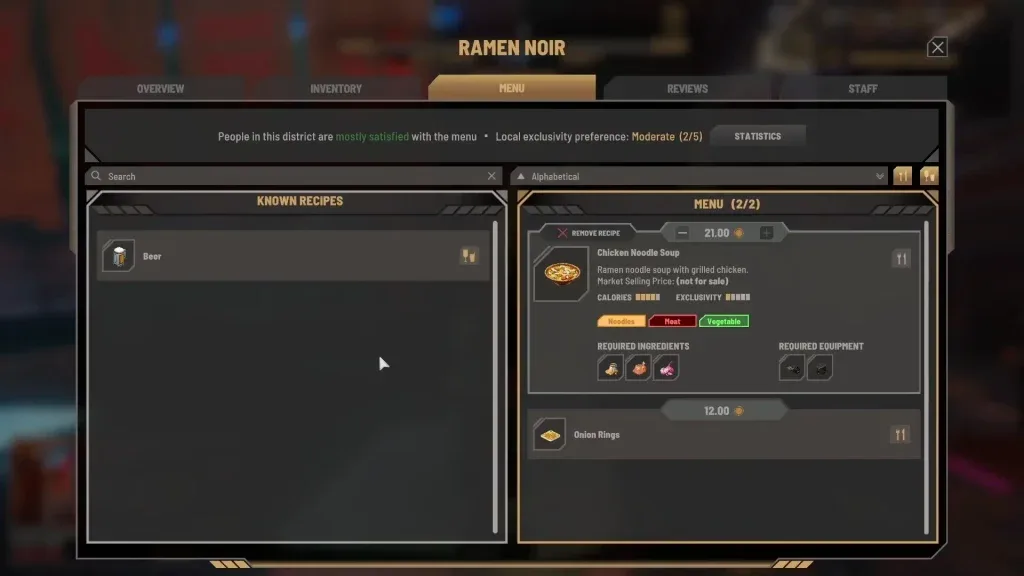
The menu screen provides several details you should check before adding a dish:
- The ingredients required to prepare it.
- The equipment the venue must have.
- Its price and the customer satisfaction shown at that price.
- The local demographic groups and their current food preferences.
- The number of menu slots available at the venue’s present level.
Ramen Noir begins with Chicken Noodle Soup, which requires ramen noodles, chicken, and onions as well as a food processor and cooker. This initial dish is useful because the required equipment is already available. Adding another item that needs an expensive appliance can drain your working cash before the new dish has served enough customers to justify that purchase.
The district preference panel is also important. During the early Ramen Noir setup, the displayed local preferences include noodles, meat, and mushrooms. Treat the current panel as a menu-planning signal rather than assuming one dish will remain optimal forever. Preferences and available recipes should guide what you offer, but the venue’s actual reviews and financial results should decide whether you keep it.
When setting a price, look at the satisfaction response shown by the menu interface. A lower price can support reputation growth, while a higher price can improve income per sale if customers will accept it. Avoid making large price changes across the entire menu at once. Adjust a dish, serve customers, and then compare the new balance and reviews with the previous result.
Before expanding the menu, apply three checks:
- Equipment check: Do not add a dish when the required appliance would consume the cash needed for ingredients or wages.
- Supply check: Make sure its ingredients can be bought, grown, or caught reliably enough to keep it available.
- Cost check: Confirm that the dish improves the final balance instead of merely increasing gross sales and shopping trips.
If a menu change creates repeated shortages or forces you to buy a costly machine immediately, remove that item and return to dishes the venue can already support. A smaller working menu earns more than an ambitious menu that cannot be prepared consistently.
Buy Only the Stock You Need
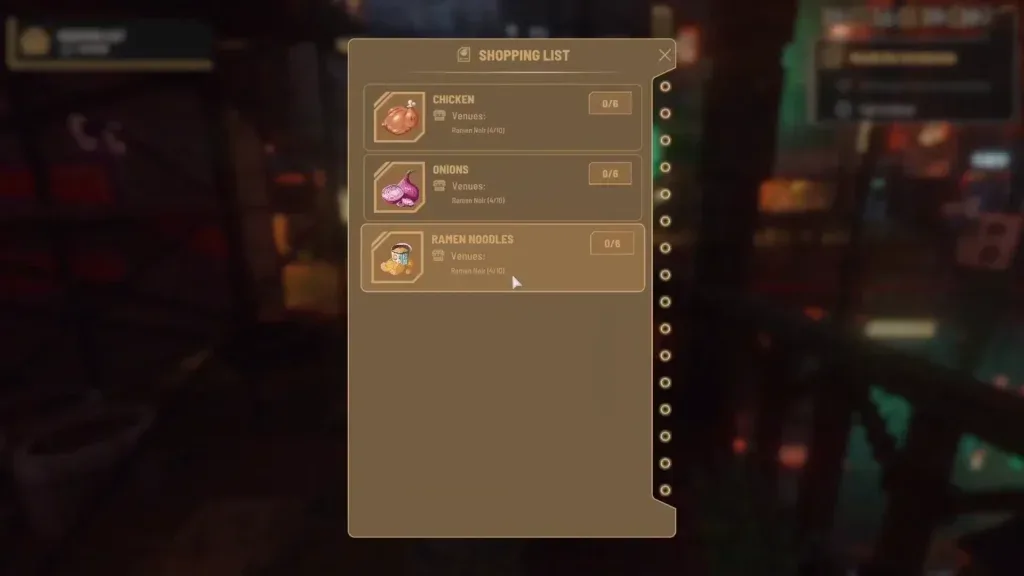
Ingredient control is one of the clearest ways to protect profit. The Shopping List shows the venue’s remaining shortage for its active menu. That number has already accounted for relevant stock, so use the displayed shortage directly; do not subtract the venue inventory from it again.
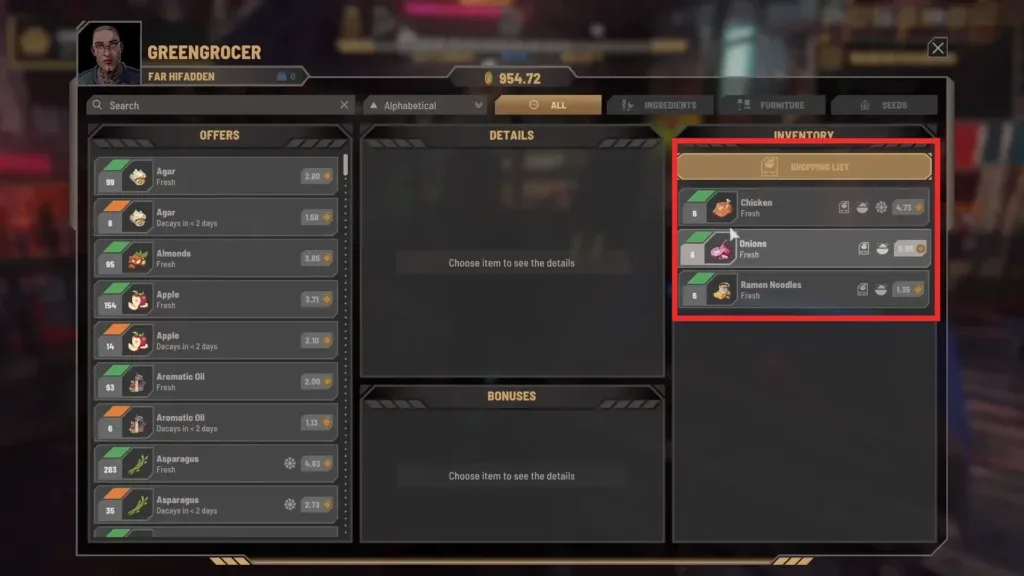
At a vendor, compare more than the sticker price. Ingredient entries can show their freshness or remaining decay period, and vendor prices change with the market over time. Your relationship with a vendor can also influence prices, while daily deals may create a cheaper buying opportunity.
Use this purchasing order:
- Check the venue you are supplying, then read its relevant entries on the Shopping List.
- Note the exact remaining shortages for the active menu.
- Search the vendor inventory for those ingredients.
- Compare price and freshness before choosing a stack.
- Buy the displayed shortage rather than a speculative surplus.
- Transfer the ingredients into suitable venue storage.
- Recheck the list before purchasing anything else.
Cheaper stock is not always the better deal if it will decay before the restaurant uses it. Conversely, the freshest option may be unnecessary when the venue will consume the ingredient during the same operating period. Match freshness to expected use instead of automatically buying either the cheapest or longest-lasting listing.
The item details also indicate when an ingredient should be refrigerated or frozen. Use the appropriate storage available at the venue. Extra cabinets, shelves, fridges, and freezers can extend storage capacity, but they are purchases that should solve a real bottleneck. Do not buy more storage merely to support excessive inventory.
Avoid stockpiling simply because a vendor has a discount. A deal saves money only when the ingredient is used or sold before its condition falls. Until you know a venue’s normal consumption, smaller purchases make shortages easier to diagnose and reduce the amount of cash trapped in food.
Control Staff Costs Without Breaking Service
Employees can cook, wait, clean, or manage, and each hired worker must be assigned one or more roles. Their hourly wage and shift length affect happiness, while their skills improve over time. The number of people a venue can employ is limited by its venue level.
Early hiring should solve a visible service problem. If the cook is constantly interrupted because the same employee is covering several roles, a waiter may help the venue serve more customers. If customers are already being served comfortably, another wage may reduce profit without producing enough additional sales.
Before hiring, compare candidates by:
- Skill in the role the venue actually lacks.
- Hourly wage.
- Available working hours.
- The schedule required to cover the restaurant’s active period.
- Whether existing staff can cover a secondary role without damaging their primary work.
After hiring, verify the role assignment. An employee on the schedule will not necessarily solve the intended bottleneck if the wrong tasks are enabled. You can allow workers to perform secondary cleaning duties when available, but keep the strongest cook focused on cooking when orders are arriving.
Do not reduce schedules or wages without watching employee happiness. Workers can become unhappy if their conditions remain poor, and unhappy staff create another operating risk. The objective is not the lowest possible payroll; it is the lowest payroll that can reliably serve the current number of customers.
Managers become available once a venue reaches Level 3, but they should not be treated as completely hands-off automation in the launch version. Their ingredient purchasing can be unreliable, including excessive purchases or failure to prioritize a needed item. If you hire one, continue checking business cash and important stock rather than assuming that automated restocking is always economical.
Use Venue Levels to Increase Earning Capacity
Serving customers advances venue progression. When Ramen Noir reaches Level 2, it can support more tables, more staff, more menu items, and a higher price multiplier. These upgrades create room for additional income, but the new capacity does not produce profit automatically.
Expand in this order:
- Keep the current seats occupied and supplied consistently.
- Confirm that the venue finishes days with a positive balance.
- Add tables only when existing capacity appears to be limiting service.
- Add staff only when the larger customer load exceeds the current team’s capacity.
- Add menu items only when their ingredients and equipment fit the available budget.
This order prevents several costs from arriving at once. Buying furniture, hiring workers, purchasing an appliance, and stocking multiple new dishes on the same day can make it impossible to identify why the balance fell.
Reviews provide another check on growth. The venue screen records customer feedback and ratings. Read them alongside the financial figures: strong revenue with weak reviews may not be a stable path, while excellent reviews do not compensate for a consistently negative balance. You need a venue that can satisfy customers and pay its own operating costs.
Add Fishing and Greenhouse Produce as Secondary Income
Fishing and greenhouse growing can both contribute to your finances, but they work best as supplements to a stable restaurant.
Fishing can provide ingredients for your venues, and surplus catches can be sold on the market. Fish values vary with the day, the buyer, and freshness, so selling promptly can matter. Fishing also consumes part of your day, which means a trip has an opportunity cost if the restaurant needs direct attention or urgent supplies.
Greenhouses can grow produce for restaurant use or market sale. Produce supplied to your own venue can reduce reliance on purchased ingredients, while surplus can become a separate source of money. Do not assume every crop is automatically profitable, however; use what your active menu needs and avoid filling storage with produce that will not be consumed.
Choose between these uses based on the current bottleneck:
- If ingredient purchases are consuming the venue’s balance, obtain useful inputs directly.
- If the restaurant is fully supplied, sell suitable surplus for extra cash.
- If the venue requires attention, postpone the side activity and protect the main business.
These systems should reduce costs or generate extra sales. They should not distract you from an understocked or poorly configured restaurant.
Delay the Second Restaurant Until Cash Flow Is Stable
Opening another restaurant can create a snowball effect once multiple venues are profitable, but expansion introduces a new purchase price, inventory, staff, equipment, and operating workload. A business permit unlock does not mean you can safely afford the next location.
Before buying another venue, make sure your first restaurant can operate without consuming all available cash. It should have a focused menu, dependable supplies, enough staff for its customer load, and several financially positive operating cycles. Keep enough uncommitted money to restock ingredients and pay workers after the expansion purchase.
A practical expansion test is simple: if buying the new location would prevent you from supplying Ramen Noir or covering its normal costs, wait. Continue serving customers, improving the first venue, and building a reserve. Expansion is most valuable when the existing business finances it rather than being weakened by it.