
Whether Nivalis Nights used generative AI to create its artwork, writing, or voices is not confirmed. The game's fictional AI assistant, Ava, does not answer that production question. Neither does the appearance of its characters. The launch-era official FAQ explains several design decisions, but it does not establish a complete policy on generative AI across the game's development.
For a player deciding whether the game meets a personal no-generative-AI requirement, that distinction matters. An unknown answer should remain unknown. It should not become a reassuring claim that everything was made without AI, or an accusation that the game contains generated assets. This guide separates the statements that actually describe development from the uses of the word AI that describe life inside Nivalis.
Three Different Meanings of AI
The search phrase can refer to three different things: generative tools used by the developers, the behavior of simulated people, or artificial intelligence within the story. Those meanings are easy to mix together because Nivalis Nights places robots and a digital assistant in a futuristic city. They nevertheless answer different questions.
Production use concerns how something was made: whether a tool generated dialogue, an illustration, a voice performance, or another asset. NPC behavior concerns what happens while the game runs: a customer waits for an order, a worker carries out a job, or a character reacts to a conversation. Fictional AI concerns who or what a character is within the setting. A game can include the last two without those features establishing anything about the first.
That means a review describing an AI-filled city is discussing a theme unless it specifically explains a development process. A screenshot of a robot supplies visual evidence of a robot in the game. It does not supply the production history of the image, the model, or the dialogue accompanying it. Keeping the question attached to the right meaning prevents a large amount of confusion.
Ava Is an In-World Assistant
Ava accompanies the player through parts of daily life in Nivalis. She offers guidance and comments on the situation, giving the city a personal voice alongside its other inhabitants. Her identity as an AI is a narrative characteristic. It is not a disclosure that her dialogue was generated by a language model or that her voice was synthesized.
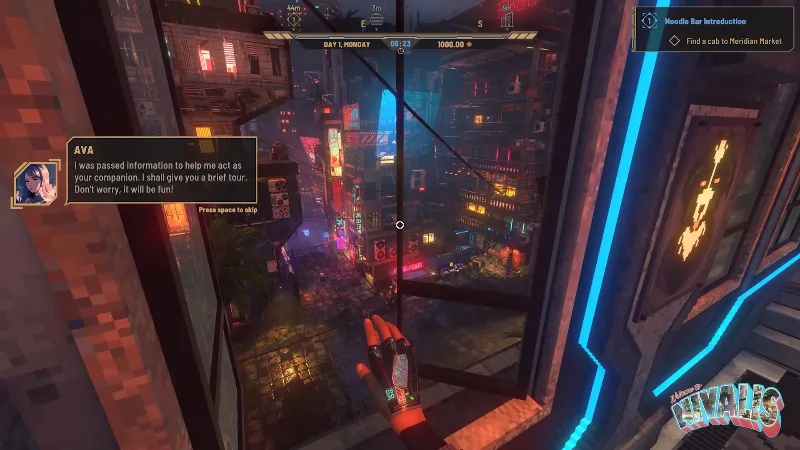
Ava is an AI within the fictional setting. This scene does not establish how the game was produced.
An on-screen conversation with Ava can establish the text displayed in that scene and how her portrait appears in the interface. It cannot establish who wrote the line, who performed it, or what tools were used before the scene reached the game. Those are separate production questions requiring a statement about the actual work.
The same distinction applies to other robots and automated systems in the city. Their presence fits the cyberpunk setting. Treating every reference to artificial intelligence as evidence about asset creation would also turn ordinary story descriptions into claims they never made. If your concern is generative development tools, Ava's fictional role is therefore useful context but not the answer.
The Character Style Has a Documented Design Explanation
The official FAQ describes a change from voxel-style characters during development to traditional character meshes. It explains that the team encountered limitations while making animations and trying to give characters more expressive faces. The resulting characters use stylized proportions and textures intended to fit the environment.
This establishes an artistic and technical reason for the character presentation. It is relevant when someone interprets the difference between the blocky city and smoother people as suspicious. The contrast did not appear without explanation: the developers explicitly discussed expression and animation as reasons for using a different character construction.
It does not, however, prove that no generative tool was used anywhere in production. A description of meshes and animation is not a complete account of concept art, textures, writing, audio, or every other contribution. It also does not say that generative tools created those components. The statement supports the particular design decision it describes, and no broader conclusion should be attached to it.
Artwork Cannot Be Certified From a Screenshot
Stylized faces, simplified textures, unusual proportions, and exaggerated lighting are all visible characteristics. They can help you decide whether you like Nivalis Nights' presentation. They cannot independently certify the use or absence of generative AI. The game combines detailed character faces with a deliberately stylized city, so judging every object by the same expectation of realism is especially misleading.
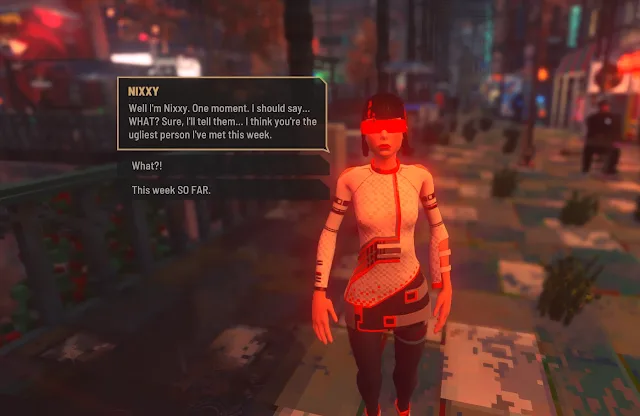
Nixxy and her dialogue panel illustrate the character style, not its production history.
The portrait and dialogue interface above show how a named NPC is presented. They are appropriate for discussing the game's character style. They are not an authenticity test. A still image contains no record of the decisions, tools, and revisions that produced it.
Likewise, a visual inconsistency would justify asking a more specific question about an asset, not announcing a game-wide verdict. The opposite also holds: a consistent and attractive scene does not prove an AI-free workflow. If the production method affects your decision, visual appreciation and production verification need to remain separate steps.
Voice Acting and Voice Generation Are Different Claims
The official FAQ says the game's audio is in English and that all characters have voice-over. That confirms the presence and language of spoken dialogue. It does not, by itself, document the creation method for every voice performance. The phrase voice-over is not a universal certification that every part of an audio pipeline excluded generative tools.
It would be equally inaccurate to call those voices generated simply because a character sounds robotic. A robot can be performed by an actor, and processing or a deliberate delivery style can serve the fiction. How a voice sounds in a scene is a different matter from whether its underlying performance was synthesized.
If voices are your specific concern, the useful evidence would identify the relevant performance and explain how it was produced. A general statement about voiced characters gives you less information than a clear statement about performers and production. Without that connection, neither a confident human-only claim nor a synthetic-voice claim is justified here.
Dialogue Choices Do Not Establish Live Generation
Nivalis Nights includes conversations and choices that influence the player's experience and relationships. A branching response is evidence of a choice within the game. It is not evidence that the response was generated dynamically by a language model. A character reacting to a choice and a tool generating new text are different mechanisms.
The official explanation describes a core narrative arc with opportunities to shape relationships and discover aspects of life in the city. It does not describe an open-ended prompt interface or promise unrestricted conversations. Players should therefore avoid reading the game's relationship systems as confirmation of live generative dialogue.
This distinction is helpful even outside production concerns. If you want a game where you can type arbitrary questions to an NPC, do not infer that feature from the presence of an AI companion. If you want authored conversations with selectable responses, the discussion of narrative choices is relevant to that expectation. Neither expectation supplies an answer about how the writing was produced before play.
A Clear Answer Needs a Defined Scope
A meaningful statement about generative AI should specify the kind of use being discussed. A statement about final artwork would answer a question about artwork included in the game. It might not answer a separate question about early concepts or internal planning. A statement about voices would not automatically cover dialogue writing or promotional images.
It should also make clear whether it concerns material players encounter in the game, material used during development, or promotional content outside the game. These categories can matter differently to different players. Someone concerned about final assets may draw a different boundary from someone who wants the entire development process to exclude such tools.
There is no need to guess which boundary a vague statement intended. If your decision depends on a particular category, keep the question specific: generated artwork in the playable game, synthesized character performances, generated dialogue, or generative assistance during production. That wording makes an eventual response easier to interpret and harder to accidentally overstate.
Until a statement covers the relevant category, the practical status for that category is unresolved. The absence of a statement does not identify a concealed workflow. It simply leaves less information than would be needed for a verified yes or no.
Making a Decision With an Unconfirmed Answer
If avoiding any possible generative AI use is a firm requirement, the current uncertainty may be enough to pause your decision. That is a personal standard applied to incomplete information, rather than a finding that the game used AI. You do not need to turn uncertainty into an accusation to decide that you want stronger confirmation.
If your main concern is the visible character design, you can assess the design directly while keeping the production question open. The explanation about meshes and expressive animation tells you why the developers chose the style. It does not require you to like that choice, and your opinion about it does not need an unsupported technical explanation.
If your question arose from Ava, robots, or a review's description of artificial intelligence in the city, the confusion has a narrower resolution: those references describe the fictional world. They do not establish generative production use. For the overall experience rather than the production question, the Nivalis Nights review addresses the game's strengths and limitations.